Reflections on Two Years Stateside

New York City Skyline at Night

Let’s just call this blog posting an update.  Since my time here in the US is coming to an end, let me offer a few thoughts on what these past two years here have given me.  They’ve been very different years–last year at America Magazine and this one at a parish.  Each has played to one of the two facets of ministry that has been especially important to me in the past: speaking to public issues, and personal care for the needy. Continue reading →

We Used to Be Just Odd… Now We’re All Sick

An old codger playing basketball.  Translation into modern terms for those who need it: “A senior  following his denial of the aging process by feeding his compulsion for basketball."

Once upon a time, long ago, we were all just ordinary people. Well, some of us might have had our quirks and been teased about them, but at least we were accepted as fundamentally sound members of the human family, oddities and all.  This woman was skinny, while that one was fat.  One person in our neighborhood was known as “loopy,” while another had graduated to being outright crazy.  The woman across the street was hot-tempered, as I recall, while her husband was known to have a strong liking for the “sauce.”  There were the moody people, and others who shed tears profusely at any little thing that happened. Then, too, there were also those who were up-tight. Continue reading →

Easter 2012: He is Risen…Or Is He?

Easter 2012: An Easter Cross at Daybreak

Long ago when I was ordained a priest, I promised myself that I would never say anything in a homily that I didn’t fully believe.  So for my Easter Sunday homily here at Oceanside, NY, I fell back on a message I’ve used before.  It’s less about pulling Easter bunnies out of hats, or finding that golden Easter egg in the hunt.  It’s more about the problems that the Easter promise presents for anyone who gives a second thought to the world around Continue reading →

The Century of the Pacific

European "New Map of the World" (1799)

Did you say the “Century of the Pacific?”  What century was that?

Was it perhaps the sixteenth, when Spanish caravels discovered the sea route to Asia and its fabled wealth?  When their navigators began naming the little specks of land they happened upon along the way and sprinkling them on the European maps of that great watery void for the first time?

Or was it the seventeenth, when Continue reading →

Doing Time

DoingTime

When a person entered the walled town he might be greeted by the sight of heads impaled on stakes or a decaying corpse swinging from a tree. Centuries ago, long before there was a United States of America, European kingdoms had their macabre ways of posting warnings that crime was not tolerated there.  Beware, all you who think that you can plunder and kill and plot against rulers, for this will be your fate. Continue reading →

What Do You Do with a Failed State?

2010 Listing of Failed States according to the "Failed States Index" of Foreign Policy

First, you find out what the term means.  Unfortunately, the Fund for Peace, an NGO that each year publishes the Index of Failed States, doesn’t seem to offer much help.  It offers a list of symptoms–civil strife, hunger, poor economic performance despite sometimes rich resources, breakdown in government services, widespread corruption, and a steady flow of refugees heading for the border.  But at bottom all these are just consequences of the core problem: a national government that is too weak and ineffective to rule. Continue reading →

A Little Time in the Desert

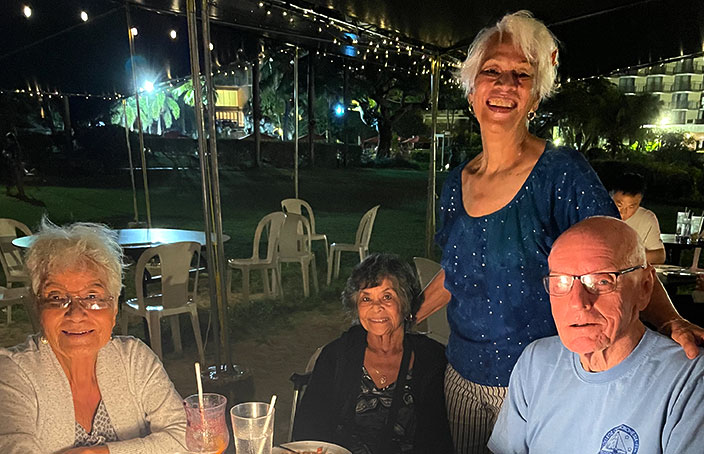
Fran Hezel, SJ, visits with friends in Las Vegas.  From left: Fran Hezel, Bob Power, Bernie Helstrom, Chai Palacios, and Trinie Cameron

Not in the spiritual desert, but in Nevada–the home of rattlesnakes, cactus juice and casinos aplenty.  In response to a request to look through the papers of Chuck Helstrom, a former TT police head who died a few months ago, I spent a few days in Las Vegas with friends.  Browsing through his files was a flip through 20 years of island history during the 1970s and 80s: heroin drug busts on Saipan, investigations into the practice of “crazy eight” handcuffing in Chuuk, death threats against certain congressmen for voting the wrong way, intrigues among the HiCom staff, and so much more. I’d almost forgotten how thrilling those days were.  How many times since then have police been sent into a village at dawn and kicked down doors to get men wanted by the law? Continue reading →

Further Thoughts on the Pacific Economies Article

The article that is posted here has already drawn several responses, not as comments here but as emails.  Perhaps I should have posted a disclaimer.  I’m not an economist, as is probably obvious to those who have read the article, but only a dabbler with a fascination in the history of economies on the world stage. Even in that area the reading list I can draw on is embarrassingly short. Continue reading →

Are Island Economies Viable?

Conference of Pacific delegates in the 1960s.

We all know that the Micronesian island nations are having problems building their economies.  Palau might be doing better then FSM and the Marshalls, but they all seem to be heavily dependant on Compact funds from the US.  Are the US-related island nations north of the equator doing worse than the rest of the Pacific Island nations?  Perhaps because they’ve become fat and lazy due to the Compact funds?

Last year, working with two Fordham graduate students, I gathered as much economic data about the island nations as possible so that we could compare the Micronesian nations with the rest.  When looked at this way, Continue reading →

Football as Religion

Football is my Religion

Many times over football has been declared America’s religion.  Maybe it is.  When I was saying mass last Sunday, the day that the New York Giants was to play the San Francisco 49ers for the NFC spot in the SuperBowl, there were lots of heavy jackets bearing the Giants’ logo.  There were also plenty of remarks after the mass about where people expected to be when the game started at 6:30 that evening.  The two religions–the one I’m supposed to represent and the one symbolized by those jackets–were meshing very nicely that morning. Continue reading →